Archivo de la categoría: Biking

Shame and sharrows

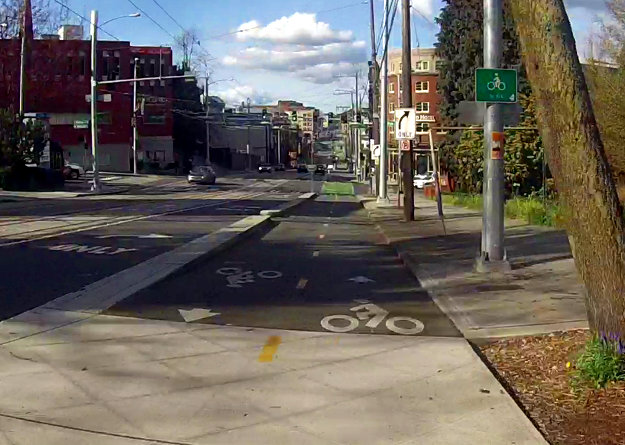
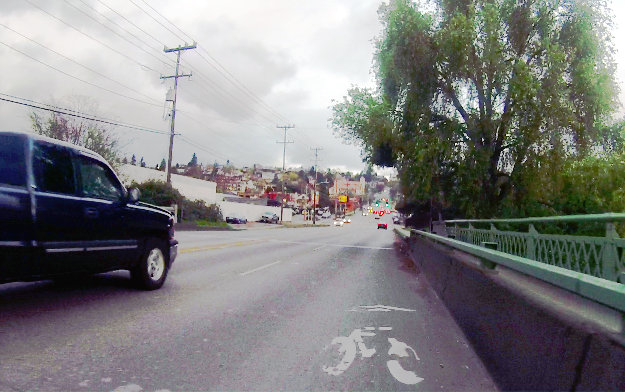
It is no secret that urban infrastructure takes generations to be implemented city wide. Thus, if you want to correct a big mistake now the changes won’t be happening any time soon. That is why everywhere in the US you see lots of sharrows and only a few segregated bikeways.
If you pay attention you’ll notice that in the previous decades driving was THE mean of transportation. That’s why you see highways going through downtown and dividing cities, streets without sidewalks, and a shamefully low number of segregated bikeways that provide for an equally low percentage of bikers.
But going back to the 50s, 60s and 70s, when politicians and people only cared about cars, some urban designers tried hard to provide even a minimum cycling infrastructure. I can imagine how hard urban designers had to fight in order to get sharrows approved when everybody was crazy about oil and cars.
That’s why I really despise new sharrows being installed instead of segregated bikeways, but I’d like to praise the few great designers who envisioned a multimodal world half a century ago.
shameAndSharrows

trafficnightmare.net

The Bike Shredder

The Bike Shredder is how i call this piece of urban design I use most days. Well, I shall say I don’t use it any day. Actually, most bicyclist just don’t. I tried it once and it is just scary because it offers a false sense of security, while exposing you to drivers with a very narrow field of view.

As you can see, the bike way detaches from the road where bicycles and cars are about to turn right. I’m sure most drivers who don’t use this intersection frequently think that a bicycle is turning right as the bike way detaches, but then, we actually turn left and join the road again on the traffic light, where most cars turn right. Also, notice there is neither protection nor paint by the traffic light.

It’s a crying shame that such a dangerous design was installed. but hey, I think it can be very easily fixed!. Here are my five cents: All we need to do is extend the bike way until it joins the sidewalk and merge both bikeways past the crosswalk but installing signals so bikers give priority to pedestrians. So simple, yet so easy to make secure!.

theBikeShredder

trafficnightmare.net

Public bikes vs Public infrastructure

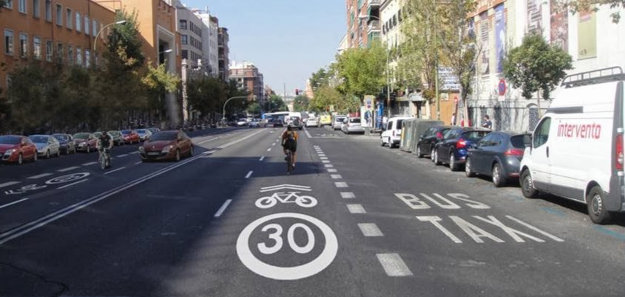
Madrid’s public bicycles are great: they include fenders, front and rear lights, they are electric, they have gears, a chain saver and even a front basket. There are plenty of them throughout the city and they aren’t expensive to use.

However, this doesn’t mean it is widely used. As a matter of fact, Madrid has 3+ million inhabitants but BiciMAD is only used about 150.000 times a day.

But why?. Well, on the one hand Madrid is quite a walkable city, but it’s also true that there are a lot of drivers which increase pollution way too much. The main reason, I think, is because the lack of bike related infrastructure. I had a really hard time finding bike ways, and even when I did, they were often blocked by tables, chairs or people because they weren’t properly differentiated. Additionally, most people will find frightening having a bike way you have to share with cars, which is what Madrid does on big avenues.

Therefore, I’d love politicians all around the globe not to think about public bicycles as an easy way to appear in the media, but to think about it in a global and organic way: Create a bike culture, provide good and safe facilities, and people will forever love you. Like the lads of en bici por Madrid ask.

bicimad

trafficnightmare.net

Guess which color are bikeways in Seattle

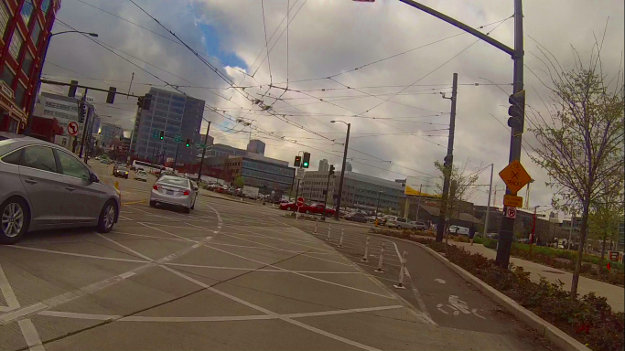
Patterns are used all around public infrastructure to help us remembering what should we do. Therefore, using different materials, colors and designs prevents drivers from remembering to look for bikes. The Scandinavian countries and the Netherlands know this well, that’s why they always use the same color and shade, and they have a very limited number of designs. However, consistency seems to be impossible to find in Seattle because the city is rather focusing on expanding its cycling facilities instead.guessWhichColorAreBikewaysOnSeattle

Bicycle innovations

Although we don’t know for sure when the first ever bicycle was designed, it clearly goes back hundreds of years. Since its invention, the bicycle has undergone massive innovation yet there’s more on its way. Here are some of the new things you may find the next time you go to the store, but be careful, some of these new innovations may not be ideal:

The shaft-driven bicycle

Shaft drives operate at a very consistent rate of efficiency and performance, without adjustments or maintenance, though lower than that of a properly adjusted and lubricated chain.
shaft

The belt-driven bicycle

A belt-driven bicycle is a chainless bicycle that uses a toothed synchronous belt to transmit power from the pedals to the wheel. The application of belt drives to bicycles is growing due to the low maintenance and lubrication-free benefits.
belt

The hub gear

Hub gears are sealed within the hub, which protects them from water, grit, and impacts. Thus hub gears usually require less maintenance. Additionally, Hub gears can change gear ratios when the rear wheel is not rotating.
hub

Airless bicycle tires

You’ll never have a flat tire if you use airless bicycle tires. Also, whether solid or not, they obviously require less maintenance.

trafficnightmare.net